Chapter 5: Composing
From Songfarmer: Writing More and Better Songs
Chapters 1, 2, 3, 4, 5, 6, 7, 8, 9, 10, Prompts, Conclusion
Composing
“I kind of try to play until I go into a semi-conscious space. And then things start arriving… You can’t question what you’re doing, because that could really get in the way of what’s trying to come up.”
- Tom Petty
“Sometimes you just put anything down… Don’t let the critic become bigger than the creator. Don’t let it strangle you… Let it go. Put a string of stuff together. Go ahead. And then futz with it.”
- Randy Newman
Flow and Edit
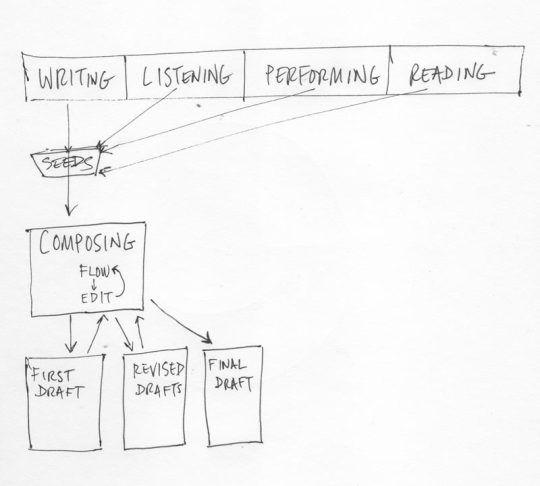
When you move through your songwriting habits, you will occasionally get ideas for songs, and they might come as situations, grooves, melodies, lines, feels, or stories. Let’s call all these ideas “seeds.” When you find a seed, write it down, record it, do whatever it takes to note the idea, so that you can develop it (possibly into a full grown song) at a later date. In many ways, all our songwriting habits are aimed toward finding seeds, setting these aside, and later, growing them into songs. Take good care of your seeds, so that any place that you store them (a notebook, an app, a program, a folder, a list, a cardboard box) should be a place where you can revisit and review them often.
Now, let’s talk about what to do with these seeds once you have them collected. It’s time for the continued use of your writing habit, but this time, we’ll be doing a specific kind of writing called “composing.” And we’ll further subdivide “composing” into two modes - FLOW and EDIT - that we can use to first grow, and then to shape, your budding songs.
We’re at a checkpoint in Songfarmer, where we have discussed habit creation and we’ve encouraged you to be sure that songwriting habits are built into your daily life, and through those habits you collect seeds. Once your farming habits have resulted in a collection of seeds, now you will water them (with the composing mode called FLOW) and then you will weed the fields and prune the plants (with the composing mode called EDIT.)
The most fundamental Songfarmer concept is, again, that there are two modes of composing: FLOW and EDIT. One is a stream-of-consciousness mode (FLOW) and the other is a critical, structural, revising and evaluative mode (EDIT). The key: Don’t try to do the two modes of composing, FLOW and EDIT, at the same time.
Can you really do two things at once? If you are like most people, you think you can, but in reality, you can’t. Many people try to do two things at once while they are composing, and they get stuck because they evaluate what they are creating too early in the process before giving their ideas a fair shot.
FLOW. The earliest, initial mode of composing is a freeform, no constraints, stream of consciousness, keep-the-pen-moving, keep-the-keyboard-clicking, dumping of thoughts, feelings, and images onto the page.
EDIT. The follow-up mode of composing (that should be used in later phases after a sufficient FLOW session) is structured and evaluative. It is focused on rhyming, order, and making the most of the raw materials (words and sounds) you produced during the FLOW mode.
The two functions cannot be performed at the same time, and a very strict separation of the use of them will help you produce more songs. There is a time for FLOW, and there is a time for EDIT. You will go back and forth between these two functions throughout the process of composing a song, but you cannot do them both at the same time, and if you try to, you will get frustrated and shut down the creative drive. Imagine an iterative, repeating, back and forth switching between these two modes as you compose: FLOW and EDIT, FLOW and EDIT. Repeat as necessary until you determine that the song is finished.
If you are working on a particular section of a song, a line, or even trying to find a particular word, the back and forth use of FLOW and EDIT will serve you well.
Here are some typical characteristics and features of both modes:
| FLOW | EDIT |
|---|---|
| open | closed |
| intuitive | intellectual |
| subconscious | self-conscious |
| subjective | objective |
| dreamlike | wide awake |
| open channel | dams and gates |
| relaxed | reserved |
| play | work |
| internal | external |
| accepting | critical |
| free | constrained |
| listening | reacting |
| pouring | structuring |
| liquid | solid |
| go | pause |
| raw | filtered |
FLOW
Think about writing lyrics in the FLOW mode as an emptying of thoughts and just write down words and connections as they appear without evaluation, hesitation, or critique. (This FLOW process applies to composing melodies as well, and FLOW with music ideas is discussed specifically later in this chapter.) Just as water will find a way around barriers, so you should allow your thoughts to move to the page when you are in this mode. Try using the FLOW mode to free write for either a set period of time or for a set number of pages and:
- don’t worry about rhymes
- keep the pen moving, don’t evaluate, just generate
- don’t use backspace if you are using a computer
- create a “junkyard” or “wild zone” of material to pick through later
- don’t focus on punctuation, capitalization, or correct spelling
- put down whatever words or images cross your mind, even if they are expressions of doubt or uncertainty, keep writing words down!
Trivia: Bob Dylan wrote “Watching the River Flow” on a notepad in the studio, on the day they recorded the song, in ten minutes. Leon Russell, the producer of the session, reported that he saw Bob was writing in an automatic, flow mode that initially resulted in a few lines expressing doubt about being able to write. Bob nevertheless wrote his doubts down with no editing, and the flow of words kept coming until they became the narrative that is the song’s lyrics. But the first two lines of “Watching the River Flow” are:
What’s the matter with me
I don’t have much to say…
The moral: Write down whatever comes to mind during the FLOW mode and keep writing.
Flow Exercise 1:
Create a Junkyard or Wild Zone of Words
Is there any subject you would like to write a song about? What are some words that might be in a song about ________? List them and keep going until you fill one, two, or three pages. This list of words and phrases will be what we call your “junkyard” or a “wild zone” that we will pick through during later EDIT phases.
Flow Exercise 2:
Listing of Thoughts
Without using paragraphs or punctuation, just start listing words, phrases and sentences that cross your mind and don’t stop until you get to the bottom of two pages.
EDIT
Use the EDIT mode to refine, polish, structure, and ask questions that will help you make decisions about your song lyrics.
In EDIT mode, search for key phrases:
Do any of the words or lines you have produced look like an intriguing first line?
Do any of the words or lines you have produced look or sound like the title of the song?
Can you think of some words that rhyme with these key phrases? (Go back to FLOW mode to produce other rhymes.)
Wild Zones and Manicured Zones
Think about the FLOW mode to be like watering your fields to see what grows and to see what springs up from the soil of your experience. When you are flowing, you are pouring out a stream of words, thoughts, and sounds without regard to anything beyond just keeping it going. Think about the EDIT mode as the pruning, the weeding, and the careful moving of the tiny plants that the fields produce after plenty of watering.
Let’s also propose that most of us use two different zones of farmland (or at least two different fields): one is a wilder zone and the other is a more manicured and regulated zone. We FLOW (or water) to produce growth in the wilder zone, in the more natural field. Once we begin the EDIT mode (pruning, weeding, selecting), we are moving our upstart plants to a more manicured garden zone. Of course, we can still water or FLOW once something has moved to the manicured zone, and we will have to FLOW to keep it growing, but in a more focused way.
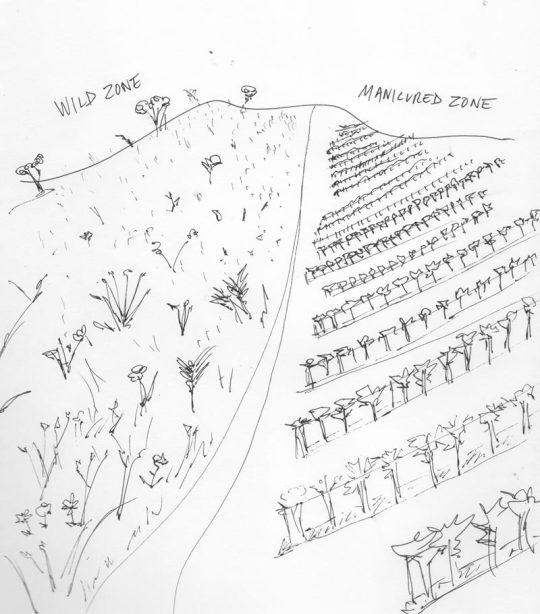
What does this mean practically? It probably means that you have pages or a notebook or a recorder for your stream-of-consciousness FLOW output of words and sounds, and then when you switch to EDIT and decide you like something, you write it down on another page or in another notebook or put it into another recording. In other words, your ideas are slowly graduating from a jumble of sounds and scribbled ideas to initial melodies and structured lyrics as they pass through your editor’s judgment and your various filters.
Composing with a Song Seed
A routine that should be in the mix of your songwriting habits is, of course, the act of composing, or the assembling and creating of lyrics and music. You might begin a composing session with a seed for a song, collected in the course of your normal songwriting habits of writing, listening, performing, or reading - or you might have a blank page.
Here is an example with a series of steps to take and questions to ask during a composing session that you begin with a song seed.
Review your collection of song seeds
Select an interesting song seed
Using the FLOW mode, fill up two pages with words and phrases related to your song seed
Using the EDIT mode, look through the wild growth pasture of words and phrases created during the FLOW session, looking for:
- First lines of a verse
- A song title
- First, middle, or last lines of a chorus
- Last lines of a verse
- Anything that strikes your ear or eye as pleasing
Run a second focused FLOW mode session to fill a page with words related to any of the pieces you identified in Step 4
Using the EDIT writing mode, on a clean sheet of paper, select and write down the most interesting lines or phrases from your FLOW session
Keep wild growth pages on one side of your writing area and keep clean, edited garden pages on another side of your writing area, and slowly upgrade phrases and lines from the wild growth pages to the clean, edited garden pages
You are moving words through stages of testing, almost like transplanting untamed, wild growth into a cleaner, more ordered garden zone of interesting phrases and lines
- Using a new blank page, now use the FLOW mode again to respond to the items on your edited pages and seek to:
Rhyme with interesting phrases
Set up (write what might precede) any interesting phrases
Complete (write what might follow) any interesting phrases
- FLOW and EDIT, FLOW and EDIT
Move words and phrases from the WILD ZONE you create with the FLOW mode into the more MANICURED ZONE you create by using the EDIT mode, by selecting your favorite lines and phrases
Rhyme, reorder and restructure the phrases in the manicured zones
Create more wild growth using focused FLOW mode to possibly fill in the gaps you find in the manicured zones
- Repeat step 8 as necessary, with breaks of minutes or hours or days in between each repetition between FLOW and EDIT, until you feel the song is done.
Composing with no song seed
Though your habits should provide you with seeds, let’s consider composing without a seed. All the steps above apply, but with one difference, before Step 1, you try to find a song seed in a hurry. The best way to do that is have an impromptu morning pages or FLOW session, where you keep the pen moving or the keyboard clicking until you have filled three pages with words, phrases, and lines, or until you have filled three minutes of a voice memo with grooves or chords or melodies. Next, use the EDIT mode to look through what you produced, looking for seeds, or ideas that could be explored further in the composing steps.
If you don’t find anything, proceed with another FLOW session and fill three more pages (or three minutes on your voice recorder) with thoughts, lines, ideas, stream-of-consciousness rambling, anything. Again, once the pages are filled, switch to the EDIT mode, and look for a song seed. If you find one, begin Step 1 above. If you don’t find anything, you might have to postpone your composing session, and instead complete one of your routines of writing, performing, listening or reading until you find a song seed.
All the same steps apply to composing with a lyric seed, a melody seed, or a groove seed. The primary difference is that with melody and groove seeds you’ll use a voice recorder more than paper or a text document. Let’s talk a bit more about starting from a musical seed in the next section.
Composing a melody
When you are seeking melody and grooves, we can defer to a certain wonderful, mysterious, and comforting fact about the brain, and that is: bits and pieces of melodies you have heard over your whole life - fragments from your entire of life of exposure to music - are available to you as a composer. And, obviously, the more you practice the habits of listening to songs and performing your instrument, the more bits and pieces of melody and rhythm you will have at your disposal.
You will “find these bits and pieces” of music by opening up the gates and having a FLOW session with your instrument and/or by singing ideas. Maybe you have actual words or nonsense words attached to the melodies or maybe it’s just la, la, la or blah, blah, blah. The bottom line in FLOW mode is to get the ideas down, so don’t judge them, evaluate them, or shut them down with your EDIT mode.
With musical ideas, unless you can write in musical notation, many times you will be using a voice recorder instead of paper to get down your FLOW session and for your wild zones, so, obviously, you will be singing or performing your melodies for playback later instead of writing down words. When you play back your recordings made during a melody or groove FLOW session, you will switch to your EDIT mode to listen for interesting or satisfying melodies or rhythms. While still in your EDIT mode, reproduce the interesting or satisfying melody or rhythms by performing them again into a second recording that will serve as your manicured zone.
Once you have moved some ideas to a manicured zone, you have mapped some or all of the musical structures of a song. These musical phrases will show you the number of syllables or words you need to fill those spots. For example, you might sing a piece of the melody and note how many “blanks” you need to fill in with lyrics.
Whether you start with musical or lyrical song seeds, use the FLOW composing mode to expand, experiment, and create, then use EDIT composing mode to evaluate, select, structure, and decide what to keep. See your first early pages, documents, and voice recordings as wild zones, and then, as you make commitments to certain lyrics and melodies, create manicured zones on new pages, documents, and voice recordings.
The iterative move between FLOW then EDIT, FLOW then EDIT, always applies as you write words, sing, and play, until you get the sense that, “yes, this is the way these words should be sung,” or “no, I need to keep FLOWing ideas until I find the notes to fit these words (or the words to fit these notes).”
A song is a marriage of lyric and music, and composing with the FLOW and EDIT modes will help you to find a good match, regardless of whether you start with a lyric seed or a music seed. The most common question asked of songwriters is: “which comes first the words or the music?” By now you recognize that it doesn’t matter what you begin with - the main thing is to begin. Then go back and forth between creating options, making choices, creating options, and making choices.
Brian Wilson says that he writes melody by:
Choosing a key
Playing chords in that key until he finds a progression of chords and a rhythm for them he likes
Then he starts either singing nonsense words or lyrics as he moves through the progression until he likes a melodic line
Some songwriters find that composing melodies by singing, without playing an instrument, can lead to more inventive melodies. Some other songwriters use their instrument to create a progression of chords and rhythms that suggest a feeling or mood, and then they begin composing words that match that feeling or mood (or that contrast with that feeling or mood). Create options, make choices, create options, make choices, is another way of saying FLOW, EDIT, FLOW, EDIT.
When you create options, you will be attracted to some directions more than others, and you will choose them. Then those choices will be connected to other options, some of which you will favor more than others, and then those choices will suggest further options, and the process goes on and on, until the song is finished. The underlying criteria for the choices you make are your subjective tastes informed by all your life experiences and by your habitual study of music and language. You will choose what interests you, what delights you, and what you find beautiful or compelling.