Chapter Eight: Strengthening Habits
From Songfarmer: Writing More and Better Songs
Chapters 1, 2, 3, 4, 5, 6, 7, 8, 9, 10, Prompts, Conclusion
Strengthening Habits
“If you wait around for inspiration to happen and are not conducting a creative life where you’re involved with your music and your instruments, then that inspiration will happen and you’ll have a couple good ideas and it will be gone before you can respond to it. ”
- Jackson Browne
“Whatever I hear becomes part of my vocabulary… Whatever you listen to, it becomes part of what you do.”
- David Byrne
Your GOAL and your four key songwriting HABITS (writing, listening, performing, reading) will help you collect SEEDS. Then you can then take a seed and begin to compose with FLOW and EDIT, moving budding words, phrases, lines and melodies from WILD ZONES to MANICURED ZONES, until they are finished SONGS. Using the habits and FLOW and EDIT will get you more songs, but one more exciting proposition is that the habits will get you better songs too.
The four habits will make you the director of your own learning, and, through their use, you will lead the study and design that allows you to develop your skills and knowledge. Your habits will direct daily attention to works and concepts that you find inspiring and useful.
Your writing habit will keep you noting the ideas that cross your mind and it will help you create rich junkyards or wild zones of FLOW free writing. It will keep you collecting seeds where you might have neglected them in years and months past. Your performing habit will help you learn new chords, gain confidence using your voice, and upgrade your motor skills at playing the piano, guitar, or whatever instrument you use.
Your listening habit will continually present intriguing and inspiring songs to you, and your close attention will help you see how other artists solved problems and made the most of their ideas. Your reading habit will direct your attention to language and storytelling that can teach you how to use beautiful language and principles of good storytelling in your own songs.
In summary, the writing and performing habit will get you accustomed to producing words and melodies, and the listening and reading habits will help you acquire knowledge and skills by enriching the soil of your mind. In many ways, writing is the interaction of your senses and memory, requiring you to combine ideas from both your current and past experience. Reading and listening provide a steady incoming stream of images, sounds, and words, and they are good ways to load new stimulating experiences into your memory where they can intermingle with the experiences of all your previous days on the planet.
In summary, to attempt to say the thoughts above in the fewest possible words:
GOAL + HABITS = SEEDS
FLOW & EDIT grows SEEDS into more SONGS
GOAL + HABITS = improved SOIL and better SONGS
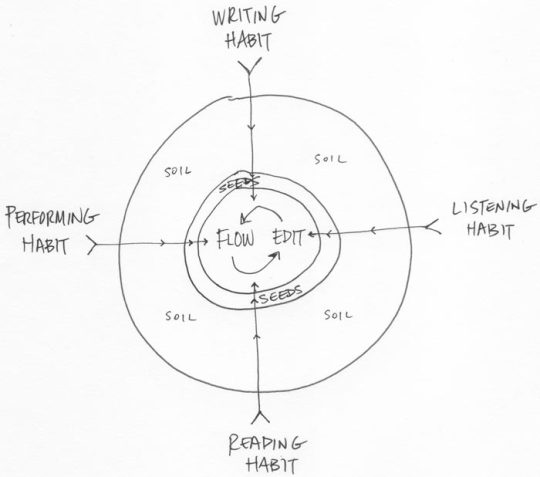
Another visual model to show how songwriting habits will result in seeds you can use to compose songs. Note also that the inputs of each habit, whether they result in a seed or not, will enrich the surrounding knowledge and experience, the soil, of the songwriter.
In this section, we will dig into the habits a little deeper and we’ll show you how to use them in a more advanced way. By understanding the three part structure of habits - cue, routine, and reward - you may be able to cue your habits more, execute the routines more, and reward yourself for completing them.
Cues
We are trying to strengthen our habits, and any habit is made of three components: a cue, a routine, and a reward. Here’s an example of the three components in action, in Owen’s coffee habit:
“When I wake up in the morning, I walk in the kitchen and see the coffee maker. Seeing the coffee maker is the cue for my coffee habit. The routine I perform in response to the cues is: filling the machine with water, putting a filter in, measuring coffee into the filter, and flipping the switch to brew. The reward is the aroma and taste of coffee (which I love) as well as the stimulation I get from the caffeine. I have a habit of drinking coffee, I perform the routine when I see the cues, and then I get the reward.”
Let’s look closely at the sequence of cues, routines, and rewards to decide how to strengthen the four habits of songwriting.
Examples of songwriting cues can be:
- a guitar sitting out on a stand (not hidden in a closet)
- a piano
- a blank notebook
- listening to a song or an artist you admire
- a book on songwriting
- a written goal to write a song posted in a place where you see it regularly
- a friend who asks to hear a new song
- language you admire in a book or a poem
- a strong feeling about something going on your life
- a memorable phrase or piece of conversation
To strengthen the habits of songwriting, keep songwriting cues present and visible in your environment. If you don’t have cues to write songs in your environment, try to find a way to get those cues into your daily life. A written goal in a place you will see it is a powerful cue. A notebook and a pen (nearby at all times) are very helpful cues for a writer.
More from Owen on a notebook cue he uses:
“In my own life, when I keep a notebook by my bed, it’s a very visible cue in my environment and a constant reminder of my goal to write songs. I know I am serious about finding seeds for songs when a notebook is one of the last things I see at night and when that same notebook is one of the first things I see in the morning.” Bottom line: decide what cues might work for you and build them into your daily world.
Routines
To use the language of habits, songwriting routines are the sequence of actions you perform after you hear or see a cue. Some routines that we have already discussed so far include: free writing in a journal, singing or playing a chord, listening to a song closely, or reading pages of fiction. All these routines can be used to help you collect seeds and improve your skills and knowledge. Once you have seeds, you can use the seeds themselves as a cue to perform a composing routine.
One tip: do your most difficult routine first thing in the morning as it is the one most likely to get procrastinated. Maybe that means a writing mini habit (50 words of free writing) is one of the very first things you do in the morning, before even looking at email. In your routine, use the same tools and materials day after day to smooth your workflow. Select tools that inspire you, with designs that fit your needs, because they will make completing your routines more enjoyable.
Is there a particular style of pen or notebook that feels right and is aesthetically pleasing to you? Buy a few extra to keep on hand. However, do try to use just one notebook at a time rather than keeping notes spread among the first five pages of five different notebooks. Write down phrases and lines from movies, books, and conversations in your notebook. Take notes several times a day in it, and also take notes on your smartphone.
Regarding tools, here are a few choices we have heard friends talk about that you might consider for your own songwriting toolbox:
- Notebooks with unlined pages (sometimes better for freeform FLOW mode)
- Notebooks with lined paper (better for EDIT mode)
- Graph paper (yep, also sometimes better for EDIT mode)
- Particular pens or pencils
- Computer program where final versions of song lyrics can be composed or stored (MasterWriter, Scrivener, or just text documents in a folder)
- Voice recorder or voice memo app on smartphone
- A folder on your computer to keep rough acoustic demos of songs
- Rhyming dictionary book or online (we like RhymeZone.com best)
Rewards
The reward you get for completing a routine will usually be a feeling of satisfaction at getting it done or the songs that eventually result from the work, but feel free to add other rewards to the system. For example, you might write a newly completed song onto an ongoing list of your compositions that you keep. Anything else you enjoy and could use to celebrate completing a routine might be a good prospect for a reward too.
There is a plethora of apps and websites for tracking completion of routines (www.chains.cc, Momentum, and beeminder.com, for example), but for us, the best tool for getting a sense of reward and completion, is checking off the days on a wall calendar or a single summary of the month’s tasks. In our opinion, there is still something more intrinsically rewarding about marking a routine or a mini habit as “completed” with paper and ink. You might find it gratifying to see a hard copy record of the days you completed the commitments you made to yourself. It is rewarding to see tangible evidence that you are moving forward with your habits and building skills.
Owen describes the way he posts his progress:
“I use year-at-a-glance wall calendars and put a check mark on days when I completed all my mini habits. I also make a monthly record using graph paper. On the graph paper I write the month name at the top and then list 1 through 30 or 31 for the days in the month on one row. Then, on the left side of the page, I write each habit on a different row, so that I can put a check on the row for that habit for each particular day of the month.”
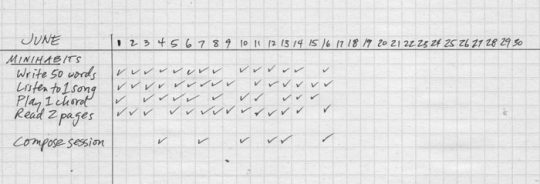
The point is, don’t assume digital records and digital to-do lists are more rewarding or motivating than paper-and-ink lists. Thousands of years of evolution have made the act of making a physical mark on a surface more rewarding than any digital check marks. Go with whatever works for you and gives you a sense of satisfaction after completing the routines to strengthen your habits.
Belief
The final essential component to an ongoing habit is belief. To keep a routine going, you must believe that is worthwhile and that more and better writing is possible if the habit is maintained. Belief is best cultivated in interactions with other people, so plan on seeking out one or two or more people with whom you can share your habit creation successes and challenges. Find a community of songwriters you can join to refresh, rebuild, and sustain belief, so that you can create and maintain your habit of songwriting.
Belief can also be reinforced by books by other people who have done the work you are doing. You can strengthen belief with interviews and advice straight from some of the world’s best songwriters in the books Songwriters on Songwriting by Paul Zollo or And Then I Wrote by Tom Russell and Sylvia Tyson.
Be assured: your habits will fill and refill your collection of seeds and your habits will enrich the soil of your mind. Keep in the groove with your habits by performing your instrument, listening to songs, reading words, and writing notes/journals/morning pages, and the seeds and skills for more and better songs will inevitably come along.
Lists
Keeping a few lists on hand is good way to keep your habits supplied with incoming fresh material. Think about lists as cues for routines you want to perform. For your listening habit, keep lists of songs or artists you have heard recommended by friends or other trusted sources, so that when you have a crosstown drive you can cue up the song or a new album to listen to.
For your reading habit keep a list of movies and books to read. Because folks who tell stories well are a good source for song ideas, you might even keep lists of people to make a point to talk to regularly and listen to them closely for song ideas. Fiction, spiritual texts, history, and poetry are all good genres for songwriters to read. For your performing habit, keep lists of chords to learn and songs you want to cover. Remember that, in addition to piano or guitar, your singing voice is also an instrument, that the more you use it, the stronger it becomes. For your writing habit, in addition to actually working on song lyrics and music, you should keep lists of writing techniques and routines like journaling, writing-all-the-time, morning pages, and creativity appointments to use in this habit.
Writing Routines
Journaling
You can create rich soil for songs and find and collect seeds with a journaling routine. Any topic is fair game - anything on your mind can go into the journal entry. Some of what you write down will be feelings, things you need to do, reports of recent activities, things you’re looking forward to, or things you are worried about. Use the opportunity to write down beautiful, remarkable, or surprising things you noticed in the events of your day. Think of journaling as exercise for your noticing, reflecting, feeling mind.
Note-taking
Regular journaling is an important writing routine, but another kind of writing routine can potentially be happening all the time. “Writing-all-the-time” is a mindset, a practice, and a discipline. All it requires is a notebook, a cocktail napkin, a note-taking app on your smartphone, or the back of a receipt.
“Writing-all-the-time” is a decision, a commitment you make to yourself, a promise to take notes when ideas cross your mind, whenever and wherever you are. The discipline of “writing-all-the-time” requires you to write down the ideas you have when you have them, and not to say “oh, I’ll write that down later,” because, of course, you won’t write it down later. You will forget the idea you had. Also: “Writing-all-the-time” requires you to not judge or evaluate your idea - only to record it in a place you know you will see it later.
Many professional musicians do not compose drafts of songs while touring or on the road, but say they do take notes while on the road. Then later, back home or off the road, these pro songwriters will expand these collected notes into drafts of songs.
Creativity appointments
Actually performing songwriting routines on a daily basis is the best way to strengthen the songwriting habit. We know how hard it is to do anything on a daily basis, but it’s not impossible. Most people brush their teeth every day. Some people wait to be inspired to write, but in our experience, we are more likely to be inspired while writing rather than waiting to be inspired to write. “Showing up” - setting aside the time to write - is the most basic and necessary requirement for a song, but additional sessions can be scheduled beyond your daily mini habits, so consider making a creativity appointment with yourself and committing 5 to 25 minutes to focus on one of your songwriting habits. Shut the door, turn off the phone, close down the internet browser, and open the notebook.
Procrastination
Procrastination sometimes comes along in the form of over-preparing and waiting for ideal times and conditions. You find ways to delay composing a song because, “I need to collect more seeds” or “I need a stronger idea to start with” or “I need my usual notebook to write” or “I need a longer block of time to get anything done on the song.” When you see these kinds of statements in black in white, you probably realize that they are just the different masks and disguises of stalling and fear of failure. They are excuses that prevent you from getting to work. So remember, in course of your habits, your quantity goal of finished first drafts of songs should keep you completing and finishing songs, not just planning and preparing for songs.
Revisit your writing
Regardless of what songwriting routines you perform, whether journaling, writing-all-the-time, or creativity appointments, plan on revisiting all this writing at regular intervals to look for song ideas.
Owen talks about his writing routine:
“My own writing routines include a daily mini habit of writing 50 words of morning pages and then throughout the day, I write down every seed idea I have. Then once or twice a week, I set make a creativity appointment with myself to review seeds and compose from a seed (FLOW then EDIT). I usually structure composing into three 25-minute blocks with two 5 minute breaks built in, so that’s 25 focused, 5 break, 25 focused, 5 break, 25 focused for a total of about 85 minutes. During this time, I review seeds, then FLOW, EDIT, FLOW, and EDIT to see if I can get a song growing.”
Performing routine
Getting better at your instrument will make you better at playing and writing songs. No matter what instrument you play, chords are your friends when you are writing a song, so always be looking for a chance to learn a new chord. Take on the viewpoint of a chord collector, and you’ll always be interested in getting a new one added to your collection.
Learning some music theory - the principles of harmony and melody - can also provide you with seeds, enrich the soil of your mind, and serve as a subject you can tackle in small pieces your whole life. Reading a book on guitar or picking up a new instrument to play, like harmonica or piano, can also influence your songs for years to come. Regularly learn how to play and sing songs you’ve always admired. By deconstructing the lyrics and chords, you’ll see up close how the songwriter built it, and then you can emulate it in your own songs.
Listening routine
The melodies, harmonies, and rhythms you have heard throughout your life are stored in your brain, and the music you expose yourself to will inform your future songwriting. Each of us synthesizes the sounds we have heard throughout the course of our lives to get melodies, harmonies, and rhythms for the lyrics we write.
Explore the great music you haven’t heard. Get a list of highly esteemed music from a source you trust (a friend, blog, or book) and regularly listen to the artists or songs that are on that list. Always have an artist, album, or song list that you are working through, and closely listen to the works on that list as part of your listening routine.
Reading routine
In many ways, the reading routine can also be considered a story routine. Getting lost in the stories you watch, read, or listen to is a great feeling. However, when you are “working” on your reading or story routine, one idea that can help you develop as a storyteller is to be mindful and analytical as you read, watch, or listen to stories. When possible, try to track the structure of the story and notice how your attention is carried on through, scene by scene, to see how the characters are changed by their experiences. Two books - Robert McKee’s Story and Joseph Campbell’s The Hero with a Thousand Faces - are helpful for understanding the form of stories that move through a classical arc from conflict to resolution.
Reading poetry exposes you to compressed, condensed imagery, and religious texts and scientific publications can bring you stories from a wide perspective. Fiction and biography will often drill down into a narrower perspective inside the life of one individual and their feelings and social interactions. Exposure to all this language will help you make effective songs.
In addition to reading books and seeing films, the reading and story routines can also be employed in listening closely to the stories told by the people around you. The most common advice to writers is “write what you know.” Listening closely to stories, words, and sayings of many different kinds of people expands what you know about, and the more you know about, the more you can write about.
And don’t forget to read your own work. You can and should revisit and reread old notebooks. Sometimes an idea from years ago will be sitting there, waiting for your present-day self to see it and understand it in a new way. (Because you will reread and revisit old notebooks, this is a good reason to write in one at a time and fill up all the blank pages to the end of the notebook, because this will result in fewer old notebooks you have to store somewhere!)
Now that we have discussed ways to strengthen habits, let’s consider a framework for designing memorable songs.