Chapter Nine: Stickiness
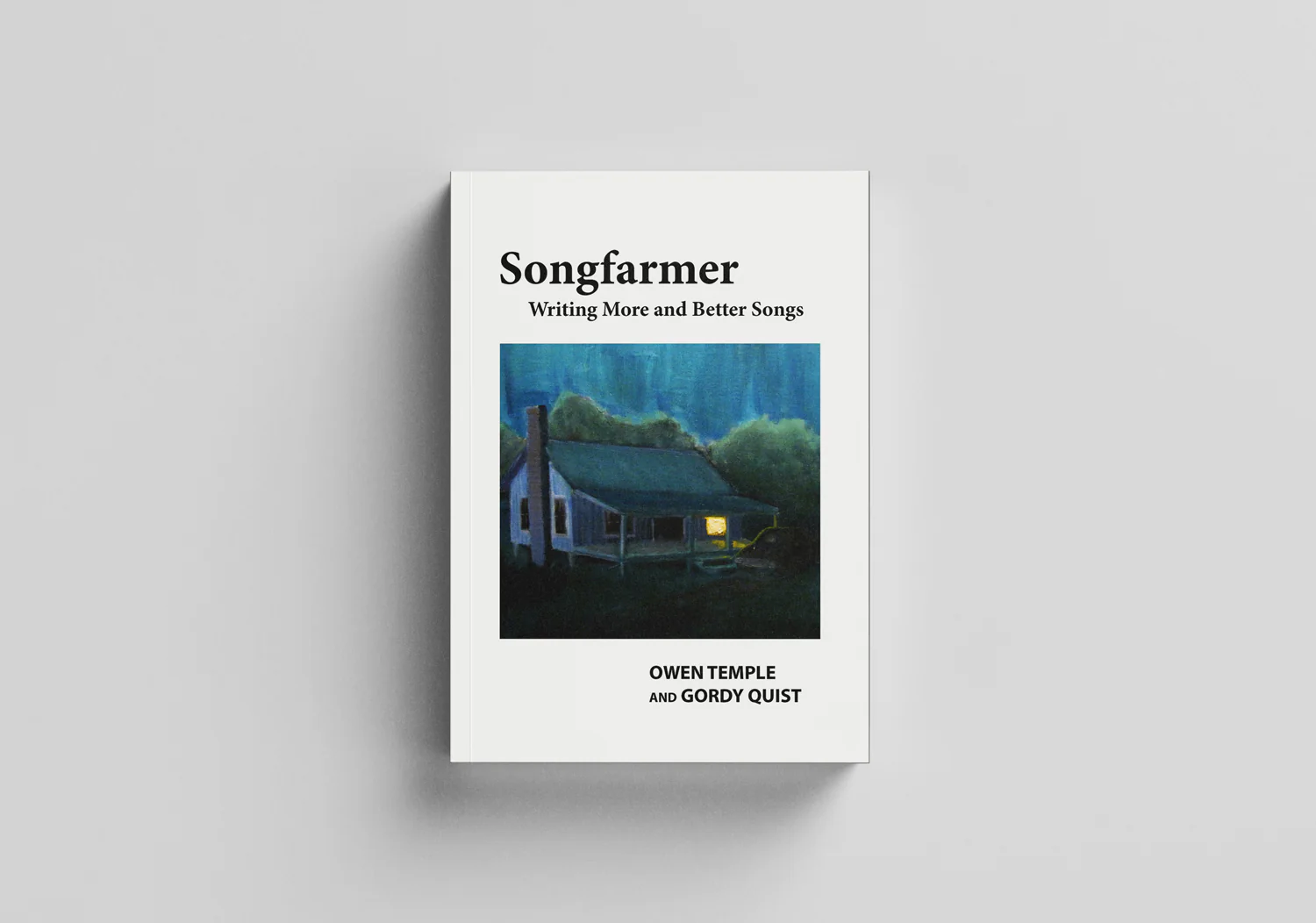
From Songfarmer: Writing More and Better Songs
Chapters 1, 2, 3, 4, 5, 6, 7, 8, 9, 10, Prompts, Conclusion
Stickiness
Write down your answers to the following questions: What do you want a song to make people feel or understand? What do you want them to do? Do you want them to stand up and sing along, do you want them to cry, or do you want them to play it at their wedding? By writing a few goals for the song you write before beginning a FLOW process, you can sometimes wind up with a song that meets your goals. “Better songs” can mean songs that accomplish the goals you set for the songs. Some songwriters want their next song to be the one that:
- People play at full blast at the summer keg party and sing along to
- People dance to at a country bar
- Inspires their songwriter heroes to send them a message to say “well done”
- Gets played on the local radio station
- Is popular among college students
- Will get you booked at a folk festival
The bottom line is that “better songs” can only make sense in regard to your goals for your songwriting, and your songs get better to the extent that they accomplish the goals you set for them.
One idea we believe we can all agree on: more memorable songs are generally better. We want the people that hear our songs to pay attention long enough for the song to make an impression in their consciousness and memory. Let’s use the word “stickiness” to describe how memorable a song is for a listener.
Elements of a memorable idea
In his 2000 book The Tipping Point, Malcom Gladwell proposes that some ideas are “stickier” than others. That is, they are more memorable. In a further exploration of this idea, Chip and Dan Heath, in their 2011 book Made to Stick, surveyed research on ad campaigns, urban myths, and other often repeated social phenomena in order to describe five factors that contribute to an idea’s “stickiness” or the quality of being memorable.
They created an acronym from the first letter of each of the five factors and they spell SUCCESs:
Simple
Unexpected
Concrete
Credible
Emotional
Stories
(The last “s” in SUCCESs is silent and doesn’t represent any sixth factor.)
Use the acronym SUCCESs to remember a few features you can possibly build into your own work to make it more memorable.
Simple: a core idea comes through and a central idea is clear. By trying to pack too many simultaneous messages into a song, we end up losing the main idea. Simple means we should try to make at least one central idea of a song apparent to a listener. The test? A listener can state what the song is about after the song is through.
Unexpected: A surprise that can hook and keep attention. Any element that defies or disturbs expectations will grab attention and, thus, have a shot at being memorable.
Concrete: details and talk of people, places, and things will be more memorable than abstract concepts. Vivid images are your best friend when striving for the concrete.
Credible: you believe the voice of the songwriter or that you believe the characters in the song would truly behave as depicted. Specific details can also lend credibility (as well as concreteness).
Emotional: the work elicits an emotional response as events in the song reveal how characters move closer or further from their goals. News networks and horror movie directors know how to use emotion in their stories. Strong emotion is memorable.
Stories: we store information provided in a narrative structure better than in other forms. One way to think about a story is “an interruption of a routine that is eventually resolved.” How was someone’s usual routine interrupted and how do they attempt to get the new challenge resolved? The account of an interruption and its resolution is a story, and the information embedded in the series of events is more memorable.
Details
The SUCCESs framework from the book Made to Stick is a good framework to keep in mind when you are looking for seeds and also when you are in the EDIT mode and you are looking closely at your early drafts of songs. Sometimes you will spot ways you can make your song more sticky and memorable when you are editing them.
Most lyrics will have components of more than one of the SUCCESs dimensions of stickiness. For example, very personal song lyrics are often more memorable, often because they are credible, emotional, and reveal a story.
If you get overwhelmed trying to judge all the SUCCESs dimensions to create stickiness, just keep in mind one rule of thumb: it’s very difficult to go wrong by adding details.
Details - images, proper names, place names, colors, and numbers - are reliable choices for creating more memorable lyrics. For example, consider the power of details like:
Proper names
Mary Jane’s Last Dance, Lucy in the Sky with Diamonds, Jack and Diane, Roxanne, Visions of Johanna, Layla, Eleanor Rigby, Billie Jean
Colors
Purple Rain, Purple Haze, Tangled Up in Blue, Green Green Grass of Home, Brown Sugar, Back in Black, Yellow Submarine, Red Red Wine
Numbers
1999, Thirty Days, 867-5309, One Love, 9 to 5, Summer of ‘69, Highway 61 Revisited
Place names
City of New Orleans, Viva Las Vegas, Georgia, New York, New York, L.A. Woman, Folsom Prison Blues, Please Come to Boston, Atlantic City
Why try to design for stickiness?
As we discussed in the “Why we write songs” section of Chapter 1, a song can be a tool for human connection. If, by this view, songs are tools, then the purpose of a song is to create a communication and connection between at least two human minds. Catching another’s attention and helping that other to remember features of the song seems like the minimum requirements for communication and connection. So when we are setting out to improve a song’s hooks we ask: “How can I make this more sticky?”
Simple to unexpected moves
As you consider the rhythm, chord progression, and melody of your song, remember that moves from simple to unexpected throughout the song will maintain interest and be more memorable. Use common melodic patterns plus occasional sonic surprises to get both familiarity and novelty into an ideal mix.
To tap into the unexpected component of stickiness of lyrics, try to use surprising turns of phrase or unexpected information at the very beginning of your song, so that you raise questions for the listener to get attention and draw them in. The first few lines of a song are prime real estate for snagging a listener’s interest, so make the most of it. And keep the surprises coming throughout the song whenever possible.
Ask questions
As listeners, a question requires just a touch more processing power from our brains than a statement requires. Because our brain is a problem-solving machine, it will try to answer the question. Extra processing means more memorability, so we remember when Bob Dylan asks: “How does it feel… to be on your own?” or “How many roads must a man walk down before you call him a man?”
Go personal
Only you have lived your own particular life, so the details from your experiences that you know and include will make your songs credible. And as a bonus, the events from your own life that you use are likely to have stickiness components of story and emotion.
Show, don’t tell
Our brains handle images better than abstract ideas, so when possible, convey the feelings in your song using pictures and sounds. If you give us pictures we will “see” the story or song for ourselves in our mind’s eye, rather than just take your word for it. For example, rather than saying a character “felt sad,” describe him as “looking down” or “with tears in his eyes.” Give the listener pictures and allow him or her to produce the feelings themselves. In fact, whenever possible, convey the ideas in the song as images because one way to think about a good story or song is as a waking dream. When composing, try to see what’s happening and use words to reproduce the images on the page or in the mind of the listener. Very often the difference between a good song and a great song is the presence of rich, vivid images, so use them whenever it suits your song.
Metaphors
The use of metaphor can also embed memorable images in your songs, especially if the metaphors are used consistently. We humans can break the overwhelming, abstract complexity of the world into more familiar, concrete symbols. The Oxford Dictionary defines a metaphor is “a thing regarded as representative or symbolic of something else, especially something abstract.” Songwriters use metaphors in songs, and one way to make songs better is by paying attention to consistency in the use of metaphors. Metaphors can make for “aha” moments where you show the listener how seemingly unlike things are, in fact, similar in some ways. If you are inconsistent with comparisons, the attempt can lead to confusion and frustration for the listener.
For example, if in a song you say: “our love is like a river and it flows over deserts and through the plains,” then you are saying the force, power, and persistence of flowing water is similar to a strong relationship through hardships and different settings. Now that you have made this comparison, it would be inconsistent to say: “But now our love is broken.” Why? Because you said your love was a river. How does a river break?
You get it. Once you make a comparison by using a metaphor, use it consistently, until you set up the next comparison or metaphor. Don’t mix metaphors because when you lead listeners astray they can lose patience, and a bunch of small errors can be the icing on the camel’s back.
Hooks
The bottom line: a hook is anything that gets and keeps attention. Ask yourself: What would be the first line of an interesting song? What line would get you leaning forward, turning up the volume to hear what comes next? Whatever line fits that description is a hook. If something interests you or if some idea or sound or rhythm appears in your thoughts, that’s a clue that you should explore it. Creativity and fresh ideas come from people exploring what they love and what amuses/interests/delights them. Do consider the listener’s perspective, but, at first, you will have to use your own experience and aesthetic tastes. The good news is that we are not so unique and there are other people in the world amused/interested/delighted by the same things we are. So go ahead and make something for yourself and for them.